

In his classic treatment of the evidences for the resurrection of Christ, Who Moved the Stone? Frank Morison calls attention to Paul’s undoubted knowledge of the fact that the tomb of Jesus Christ was found empty. Everyone in Jerusalem would have known this, and Paul in particular must have known of it.
Theme: The Lord’s Own Thoughts about Palm Sunday
In this week leading up to Easter, we focus on an event that shows how Jesus would have received the crowds on Palm Sunday if they had truly come to him in faith and repentance.
Scripture: Luke 13:31-35
It’s an interesting feature about the critical moments in the earthly ministry of Jesus Christ that His own comments about them are seldom found in conjunction with the events themselves, but rather you find them somew
Theme: What Jesus Demands
In this week leading up to Easter, we focus on an event that shows how Jesus would have received the crowds on Palm Sunday if they had truly come to him in faith and repentance.
Scripture: Luke 13:31-35
It’s very easy to interpret this parable of the great banquet. Sometimes the parables are hard, but not this one.
Theme: The Cost of Following Jesus
In this week leading up to Easter, we focus on an event that shows how Jesus would have received the crowds on Palm Sunday if they had truly come to him in faith and repentance.
Scripture: Luke 13:31-35
Now, if you come to the point where you understand the cost, even though you’re not willing to pay it, let me at least say that you have come a long way, and that’s a good thing.
Theme: The Chief Barrier in Coming to Jesus
In this week leading up to Easter, we focus on an event that shows how Jesus would have received the crowds on Palm Sunday if they had truly come to him in faith and repentance.
Scripture: Luke 13:31-35
Yesterday we concluded by talking about people’s resentment toward God for having characteristics that sinners hate.
Theme: Christ Is Willing
In this week leading up to Easter, we focus on an event that shows how Jesus would have received the crowds on Palm Sunday if they had truly come to him in faith and repentance.
Scripture: Luke 13:31-35
What did the people of Jesus’ day who did not like Him do about it?
Theme: The Emmaus Travelers as Eyewitnesses
From these lessons we see that the suffering, death, and resurrection of the Lord Jesus Christ were necessary in order for us to have the one true Redeemer who would deliver His people from their sins.
Scripture: Luke 24:26
Yesterday we ended by talking about the identification of Cleopas and his wife, the couple from Emmaus who had thought Jesus was going to be Israel’s redeemer, but now after seeing his crucifixion were retu
Theme: A Question of Necessity
From these lessons we see that the suffering, death, and resurrection of the Lord Jesus Christ were necessary in order for us to have the one true Redeemer who would deliver His people from their sins.
Scripture: Luke 24:26
In Luke 24:26 we read, “Did not the Christ have to suffer these things and then enter his glory?” That’s a question of necessity and it’s unlike other questions that Jesus asked.
Theme: When Hope Died
From these lessons we see that the suffering, death, and resurrection of the Lord Jesus Christ were necessary in order for us to have the one true Redeemer who would deliver His people from their sins.
Scripture: Luke 24:26
Here’s a couple who knew about these things, and Jesus appeared to them. It’s really extraordinary what they experienced and what they said. First of all, let’s remember that Mary, Cleopas’ wife, was at the cross.
Theme: Resurrection and Redemption
From these lessons we see that the suffering, death, and resurrection of the Lord Jesus Christ were necessary in order for us to have the one true Redeemer who would deliver His people from their sins.
Scripture: Luke 24:26
We ask the question, “If sensible people like that, who had seen Christ die, and who had no anticipation of a resurrection whatsoever, came to believe in the resurrection, as they most certainly did, what is it that
Theme: Three Kinds of Openings
From these lessons we see that the suffering, death, and resurrection of the Lord Jesus Christ were necessary in order for us to have the one true Redeemer who would deliver His people from their sins.
Scripture: Luke 24:26
Yesterday we said that the first opening that God does is that of opening the Scriptures to us.
Theme: From Tears to Joy
In this week’s lessons, we look at a moving event in the life of Jesus just before his arrest and crucifixion, when he weeps for the city of Jerusalem over its rejection of Him.
Scripture: Luke 19:41, 42
Theme: When Jesus Wept for a City
In this week’s lessons, we look at a moving event in the life of Jesus just before his arrest and crucifixion, when he weeps for the city of Jerusalem over its rejection of Him.
Scripture: Luke 19:41, 42
Theme: The Judgment Is Coming
In this week’s lessons, we look at a moving event in the life of Jesus just before his arrest and crucifixion, when he weeps for the city of Jerusalem over its rejection of Him.
Scripture: Luke 19:41, 42
Theme: Praying for Grace
In this week’s lessons, we look at a moving event in the life of Jesus just before his arrest and crucifixion, when he weeps for the city of Jerusalem over its rejection of Him.
Scripture: Luke 19:41, 42
Theme: Pointing Sinners to Jesus
In this week’s lessons, we look at a moving event in the life of Jesus just before his arrest and crucifixion, when he weeps for the city of Jerusalem over its rejection of Him.
Scripture: Luke 19:41, 42
Yesterday, we were talking about the need to be broken over the eternal state of the lost. I want to conclude this first application with a story from personal experience.
Theme: Two Dramas in One Story
In this week’s lessons, we look at the story of Peter’s denial, and see that no matter our sins, we can be forgiven and restored because of the death of the Lord Jesus Christ on our behalf.
Scripture: Matthew 26:75
Theme: When Unlikely People Fall
In this week’s lessons, we look at the story of Peter’s denial, and see that no matter our sins, we can be forgiven and restored because of the death of the Lord Jesus Christ on our behalf.
Scripture: Matthew 26:75
Theme: Guarding against Falling
In this week’s lessons, we look at the story of Peter’s denial, and see that no matter our sins, we can be forgiven and restored because of the death of the Lord Jesus Christ on our behalf.
Scripture: Matthew 26:75
Theme: The Need to Follow Closely
In this week’s lessons, we look at the story of Peter’s denial, and see that no matter our sins, we can be forgiven and restored because of the death of the Lord Jesus Christ on our behalf.
Scripture: Matthew 26:75
Theme: The Power of Christ’s Cross
In this week’s lessons, we look at the story of Peter’s denial, and see that no matter our sins, we can be forgiven and restored because of the death of the Lord Jesus Christ on our behalf.
Scripture: Matthew 26:75
Theme: Jesus’ Resurrection Sermon
This week’s lessons teach us about the wide variety of ways in which the whole Old Testament points to Jesus.
Scripture: Luke 24:17-37
Theme: Peter’s Sermon at Pentecost
This week’s lessons teach us about the wide variety of ways in which the whole Old Testament points to Jesus.
Scripture: Luke 24:17-37
Theme: Peter before the Sanhedrin
This week’s lessons teach us about the wide variety of ways in which the whole Old Testament points to Jesus.
Scripture: Luke 24:17-37
Theme: “In All the Scriptures concerning Himself”
This week’s lessons teach us about the wide variety of ways in which the whole Old Testament points to Jesus.
Scripture: Luke 24:17-37
Theme: Having Your Eyes Opened
This week’s lessons teach us about the wide variety of ways in which the whole Old Testament points to Jesus.
Scripture: Luke 24:17-37
Sermon: Rewards Instead of Punishment
Scripture: Matthew 28:11-15
In this week’s Easter lessons, we note the contrast between Jesus’ enemies and friends concerning the resurrection, and the price worth paying to be a witness to Christ.
Theme: The Resurrection and Jesus’ Enemies
Sermon: Rewards Instead of Punishment
Scripture: Matthew 28:11-15
In this week’s Easter lessons, we note the contrast between Jesus’ enemies and friends concerning the resurrection, and the price worth paying to be a witness to Christ.
Theme: When Unbelief Is Rewarded
Sermon: Rewards Instead of Punishment
Scripture: Matthew 28:11-15
In this week’s Easter lessons, we note the contrast between Jesus’ enemies and friends concerning the resurrection, and the price worth paying to be a witness to Christ.
Theme: A Bizarre Idea
Sermon: Rewards Instead of Punishment
Scripture: Matthew 28:11-15
In this week’s Easter lessons, we note the contrast between Jesus’ enemies and friends concerning the resurrection, and the price worth paying to be a witness to Christ.
Theme: The Reaction of Jesus’ Friends
Sermon: Rewards Instead of Punishment
Scripture: Matthew 28:11-15
In this week’s Easter lessons, we note the contrast between Jesus’ enemies and friends concerning the resurrection, and the price worth paying to be a witness to Christ.
Theme: Waiting for the Great Reversal
There are various ways Christians think about the resurrection of Jesus Christ, which is right since the Bible itself presents Christ’s resurrection in these lights. The resurrection is evidence that God has accepted Jesus’ sacrifice for sin on our behalf, for instance. Paul was thinking about this in Romans when he wrote that Jesus “was delivered over to death for our sins and was raised to life for our justification” (Rom. 4:25).
What do you suppose the reactions of Paul were as he came to Athens on his second missionary journey? He himself had been trained in Tarsus, one of the great university centers, where he had been born and grew up. The fact that Paul seemed perfectly at home in the intellectual setting of Athens reveals something of his background. He came from a distinguished university. He was visiting a distinguished university. Yet Paul was disturbed as he interacted with the Athenian philosophers. Luke tells us that they were Epicureans and Stoics, the two great schools of thought in Paul’s day.
Paul’s address begins in verse 22. When you write a formal address or sermon, you generally begin with an introduction, have three or four main points, and then a good conclusion. This is exactly what Paul does here. He has a short introduction, followed by four clear points: 1) that God is the Creator of all things; 2) that God is the sustainer of all things; 3) that God is the ordainer of all things; and 4) that we should seek Him. After this there is a conclusion which says that we should repent since we have not sought God as we should, to which he appends three inducements. It is here, at the very end, that his warning about Christ’s resurrection comes in.
Third, Paul says that God not only sustains the universe but that He also guides the affairs of men. Verse 26 says, “From one man he made every nation of men, that they should inhabit the whole earth; and he determined the times set for them and the exact places where they should live.”
Paul’s exact words were, “He [God] has set a day when he will judge the world with justice by the man he has appointed. He has given proof of this to all men by raising him from the dead” (v. 31). The resurrection of Jesus is what we remember especially on Easter Sunday when we see it as proof of all those good things that pertain to Christian people. But we find here that it is also a great warning. For it is evidence that God does not ignore sin, that justice will be meted out, and that Jesus Himself will be our judge at that day— if we will not have him as our Savior now.
The only resurrection that counts for anything is a resurrection of the body. The disciples knew Jesus’ resurrection was real when they touched His body, and it was only because of their deeply grounded conviction that He was raised that they were willing to launch out from their obscure corner of the earth to the whole of the Roman world with the Gospel.
On reaching the tomb they were astonished to find that the stone had been moved from the entrance. We can imagine them standing at a distance, afraid to go close, wondering what had happened. Who had moved the stone? Had the body of Jesus been stolen? Grave robbing was a common crime in the ancient world. Perhaps the robbers were still around. Or had Pilate ordered the body’s removal? What should they do? At last they decided the disciples should be told. So Mary Magdalene was sent back to the city to find them. Not one of them imagined that Jesus had been raised from the dead.
At this point, however, neither Peter nor John had seen the resurrected Lord. He was seen by the women first, those who had been last at the cross and were now first at the tomb. Jesus met them on their way home after they had gone to the tomb, seen the angels, and heard about Jesus’ resurrection. The angel’s message contains four imperatives which are as important for us as they were on that first Easter day for those women (vv. 6-7).
We concluded yesterday by looking at what we should see when we look into Christ’s empty grave. I had pointed out the first three of the five Spurgeon mentions. We’ll continue that in today’s lesson with the fourth point, the most important one. We must look into the tomb to see that Jesus is not in it. He is risen, as He said. He has conquered death.
How perverse are the sinful hearts of men. When Jesus was dying on the cross the leaders had taunted him, saying, “Let him come down now from the cross, and we will believe in him” (Matt. 27:42). But now Jesus had done something even greater than that. He had been raised from death. Did they believe in Him? Of course not. They could not believe because they would not believe.

Each year at Easter time, when I turn to these stories of the resurrection of Jesus Christ, I find myself wondering what I’m going to find new to preach on. When you’ve been doing this as many years as I have now, you begin to have the feeling that you have preached just about everything you can, given the rather limited corpus of material. And yet, each year as I turn to these stories, I find that there’s something there I never saw before.
The soldiers had left their post, and the tomb was empty. They must have been terrified, wondering what was going to happen to them. After the religious leaders met together, they did not seek to have the soldiers punished. Instead, the guards were told to lie about what had happened. They were to go out and say nothing about angels or a stone being rolled away, but simply to say that while they were asleep, His disciples came and stole the body.
Here’s a case, which like so many others, shows us a man who proposes a theory to explain away the reality of the resurrection. And instead of being rebuffed or forgotten, as Schofield and his book should have been, he is rewarded. It’s a case of rewards instead of punishments.
But now I want you to look at something else. I want you to turn from thinking about those enemies of Christ, who are exemplified by the soldiers and the priests on that first Easter Sunday, and instead I want you to focus on Christ’s friends, those who learned of the resurrection and who met with Jesus Christ following His resurrection.
One day there will be a great reversal. As is often the case in this life because of sin and the commitment that men and women have to unbelief, that unbelief is rewarded and the truth is punished. That’s happened before, and it will happen again. But, nevertheless, God is on His throne. The day is coming when all of that will be overturned. Unbelief will be judged, sin will be punished, and those who stand with the Lord Jesus Christ will hear Him say, “Well done, thou good and faithful servant. Enter into the joy of your Lord.”

Do you remember where that expression “Pyrrhic victory” comes from? It comes from a battle that took place between the Greek armies directed by General Pyrrhus and the Roman armies in the year 279 B.C. The Greek armies were in southern Italy, and they were engaged in a massive conflict with the Roman forces. The armies under Pyrrhus lost thousands of men, even though they won the battle, and Pyrrhus lost some of his most able commanders. And he lost all of his supplies and baggage. After the battle, one of the Greeks came up to him and congratulated him on his victory. Pyrrhus replied, “Another such victory and we are ruined.” And so a Pyrrhic victory came to refer to a victory which is a genuine victory, according to some standards, but which is won at a devastating and destructive price. Now that’s what we’re talking about when we’re talking about the death of Jesus Christ.
However, it wasn’t only the enemies of Christ that seemed to have won on that Good Friday. It was also a victory for the devil, or so it seemed. The devil had begun his onslaught against Jesus even before the religious leaders. Even before the leaders knew He was around to cause them trouble, the devil knew He was there.
Jesus is the One who described Himself in John 14:6 as the way, the truth, and the life. Jesus said, “No one takes my life from me. I have authority to lay it down, and I have authority to take it up again.” But when Jesus stood alone before this formidable foe, it seemed by any reasonable analysis, any objective appraisal, that it wasn’t Jesus who was victorious, it was death.
Yesterday, we concluded by making the point that Jesus’ resurrection is proof that God the Father accepted Christ’s sacrifice for our sins on the cross. And not only that, the resurrection is also a victory because it shows that the ravages of sin will be reversed—those ravages of sin which affect us in our bodies and eventually bring about our physical death.
Because Jesus has removed death’s sting by His death in our place, although physical death comes, for believers what follows is the receiving of our resurrection bodies. This is necessary because, as Paul himself says, flesh and blood can’t inherit the kingdom of God. You have to have a resurrection body. We have to lay aside this body in order that we might take on a new body in order to be able to be presented in heaven.

When you talk about Utopias biblically, you find that there are two. There is a Utopia in the early pages of the Word of God, the Garden of Eden, and there is a Utopia at the end in the book of Revelation. The one at the beginning we have lost and can never go back to; the one in Revelation is before us, which we can enter, but the way in which we are to enter is by the cross and the resurrection of the Lord Jesus Christ.
God gave Adam a paradise in which he had useful, meaningful work to do. God could have done without Adam of course. He did not need Adam to bring the universe into existence, nor did God need Adam to do anything once God’s work of creation had been completed. But when God created Adam He understood that part of Adam’s wellbeing had to do with significant work.
So now we have this paradise, a perfect place, with a perfect man, being given perfect work to do, and with a perfect companion. And yet, as we know, through the temptation of Satan in the form of the serpent, Adam turned his back on that paradise because he turned his back on God and he sinned.
And so we come here to Revelation 21and see the presence of God again with His people. It’s a glorious scene. We then see something else. We see described the bride of the Lamb, that is, the bride of Christ. This bride is a holy bride, a bride without blemish, without stain, a bride who has been made perfect through the work of Jesus Christ, perfectly adorned for her husband. This bride is the Church, the communion of the saints.
Our Lord was raised from the dead and because He was raised, those who are united to Him in saving faith will be raised also. You know how the apostle Paul talks about it in 1 Corinthians 15, that great chapter on the resurrection. He says that “flesh and blood cannot inherit the kingdom of God, nor does the perishable inherit the imperishable” (v. 50). But at the last trumpet, all those mortals who are united to Christ by faith will put on immortality, and what is perishable will put on the imperishable.
As we think about the resurrection on this Easter Sunday, I want to take you to a very special verse from the Old Testament. It is Job 19:25, which reads, “I know that my redeemer liveth, and that he shall stand at the latter day upon the earth.”
In the same way we too have a living Redeemer, the same Redeemer, who is Jesus. This is the thrust of our testimony on Easter Sunday, and indeed on every other Lord’s Day also. We testify that Jesus rose from the dead and that He ever lives to help all who call upon Him. The evidences for this fact are overwhelming.
What made the difference? What made cowards bold, a scattering body of individuals into a cohesive force, a disillusioned following into evangelists? Only one thing accounts for it: the resurrection of Jesus Christ.
There is a third point to Job’s statement. Not only does Job declare that he has a Redeemer, not only does he affirm that He is a living Redeemer, but he adds, quite properly, that He is his Redeemer. “My” is the word he uses. “I know that my redeemer liveth!” Do you know that “my” in relation to Jesus Christ? It is a reminder of the need for a personal religion.
The resurrection hope has come down to us through many centuries of Church history. Let it pass to our children and to our children’s children, until the living Lord Jesus Christ returns in His glory. Jesus Christ lives! He lives! Then let us tell others, and let us shout with Job, “I know that my redeemer liveth, and that he shall stand at the latter day upon the earth”!
During the first pre-Christian century a famous letter was written by Sulpicius Severus, a Roman, to Cicero, the great orator, on the occasion of the death of Cicero’s beloved daughter Tullia. The letter expresses deep sympathy and reminds the orator that his daughter had only experienced the common lot of mankind and had only passed away when the freedom of the republic itself was failing. It is warm and moving, but it contains nothing of a sure hope of life beyond the grave. In reply, Cicero thanks his friend for his sympathy and enlarges upon the magnitude of his loss.
Now trouble came into the family of Mary, Martha and Lazarus, and Jesus was not there to help them. He had been there a few days previously, but He had gone away, telling them where he was going. While He was gone Lazarus took sick, and the sickness was serious enough for the sisters to send for Jesus. The messenger who bore the report told Jesus, “Lord, behold, he whom thou lovest is sick.” There is a lesson at this point, and we should acknowledge it before we go further.
In yesterday’s study, we noted that Jesus returned to Bethany after a delay of two days. Upon arriving, He was told that Lazarus had been dead four days. This meant that Lazarus must have died before Jesus had even received the message that Lazarus was sick. And this means that Jesus knew of Lazarus’ death from the beginning and delayed His return for a specific purpose.
The story continues with Christ’s return to Bethany. Jesus does not go right into the city since the rulers of the Jews had determined to kill Him and He did not wish His presence known. Instead He waits outside. As He waits Martha hears that He has come and goes to meet Him. Mary waits in the home.
Now what did Jesus teach these women? He taught that He is the resurrection and the life. The statement is in John 11:25, and it contains two thoughts. First, in Jesus the resurrection is present, for Jesus Himself is life. Martha was thinking in terms of a resurrection at the end of time, a bodily resurrection. Jesus taught that the real resurrection, the one that makes all the difference between real life and real death, is the resurrection that takes place in the individual when he comes face to face with Himself. He is the resurrection. Where He is, there is life.
It’s a strange fact about Christianity, but one that we can easily observe, that the Gospel is sometimes better understood by those who are not Christians than by those who are. It’s not that those who are not Christians believe it. They probably disbelieve it, but at least they understand what it’s about while those who are Christians and do believe sometimes appear vague and muddleheaded in their confession.
Yesterday, we concluded by saying that during Jesus’ trial before the religious leaders, these men tried to find something they could accuse Jesus of. However, nothing they said could be established, even though many false witnesses were brought against Jesus. Two came forward and declared, “This fellow said ‘I am able to destroy the temple of God and rebuild it in three days.’” And Mark gives another detail of it: “We heard him say, ‘I will destroy this man-made temple and in three days I will build another not made by man’” (14:58).
That was very interesting, and it was so for two reasons.
Not only did they understand the teaching, but they feared the teacher. Oh, they wouldn’t have said that. They were not afraid Jesus might rise from dead. Instead, they feared that Jesus’ disciples might come and steal the body and claim Jesus had risen from the dead. But deep down underneath, who was it they really feared? Was it the disciples? That insignificant band of cowardly men who didn’t even have the courage to stand by their Lord at the time of the arrest and the trial and who scattered at the crucifixion, who were nowhere around and couldn’t be found? Was it really that weak, insignificant band they feared? Or did they really fear the Master?
And then the religious leaders came to the point in time not far from Jesus’ arrest, and Christ did this stupendous miracle of the resurrection of Lazarus. It was the talk of the town and isn’t it true that somewhere in their thinking there was the idea that perhaps, although they would have liked to arrest Him, they just might not be able to do it.
We rejoice in hearing of people becoming Christians, learning of people moving from mere understanding of the facts of the Gospel and going beyond that to saving faith in the one who did what He said He would do and rose triumphant, in order that He might live in His church by His Spirit and draw men and women to Him in this age of God’s grace.
Usually the Bible is not a funny book. The issues with which it deals are too grave. But the Bible is an honest book, and when it reports situations in life which are naturally funny it reflects them honestly and therefore with an appropriate sense of humor. There is a situation like this in Matthew’s account of the death and burial of Jesus Christ, preceding His resurrection.
Well if the Jewish leaders did not fear the disciples, what did they fear then? I am sure they would not have voiced this openly, but in my judgment what they actually feared was the resurrection. After all, they were not imperceptive, and they had been observing Jesus for the better part of three years. They had seen Him heal the sick, give sight to the blind, cleanse the lepers, restore strength to the impotent. And then, greatest wonder of all, only a few days before His arrest He had actually raised Lazarus of Bethany from the grave.
So in opposing Jesus the first thing Saul was trying to secure was his Judaism. But there was also a second item that he was desperately trying to secure, namely, himself. Later his situation during this period was described as trying to “kick against the goads” (Acts 26:14), like an animal fighting one who is prodding it to go in a right direction. This meant that, although Saul was fighting against the Christians with intense zeal, he was at the same time fighting an even more intense struggle within the secret chambers of his heart.
There was another character who got into the act. In fact, he had been leading the battle against the Lord Jesus Christ for centuries. His name is Satan. We see him first in the Garden of Eden, where he tempts Eve to eat the forbidden fruit and thus participates in the ruin of the race. We see him in Egypt and in other nations as they persecuted God’s people, through whom the Messiah was to come. At last we see him waging war against the incarnate Jesus.
I wonder if you have been confronted by the power of that resurrection. The chief priests and Pharisees tried to secure their ecclesiastical world against Jesus. Saul tried to secure his religious traditions and life. Satan had been trying to secure his evil kingdom. Perhaps you too have been trying to secure your own way of doing things or your own values or your own mastery of your time.
Each year at Easter time, when I turn to these stories of the resurrection of Jesus Christ, I find myself wondering what I’m going to find new to preach on. When you’ve been doing this as many years as I have now, you begin to have the feeling that you have preached just about everything you can, given the rather limited corpus of material. And yet, each year as I turn to these stories, I find that there’s something there I never saw before.
The soldiers had not left their post, and the tomb was empty. They must have been terrified, wondering what was going to happen to them. After the religious leaders met together, they did not seek to have the soldiers punished. Instead, the guards were told to lie about what had happened.
Here’s a case, which like so many others, shows us a man who proposes a theory to explain away the reality of the resurrection. And instead of being rebuffed or forgotten, as Schofield and his book should have been, he is rewarded. It’s a case of rewards instead of punishments.
But now I want you to look at something else. I want you to turn from thinking about those enemies of Christ, who are exemplified by the soldiers and the priests on that first Easter Sunday, and instead I want you to focus on Christ’s friends, those who learned of the resurrection and who met with Jesus Christ following His resurrection.
One day there will be a great reversal. As is often the case in this life because of sin and the commitment that men and women have to unbelief, that unbelief is rewarded and the truth is punished. That’s happened before, and it will happen again. But, nevertheless, God is on His throne. The day is coming when all of that will be overturned. Unbelief will be judged, sin will be punished, and those who stand with the Lord Jesus Christ will hear Him say, “Well done, thou good and faithful servant. Enter into the joy of your Lord.”
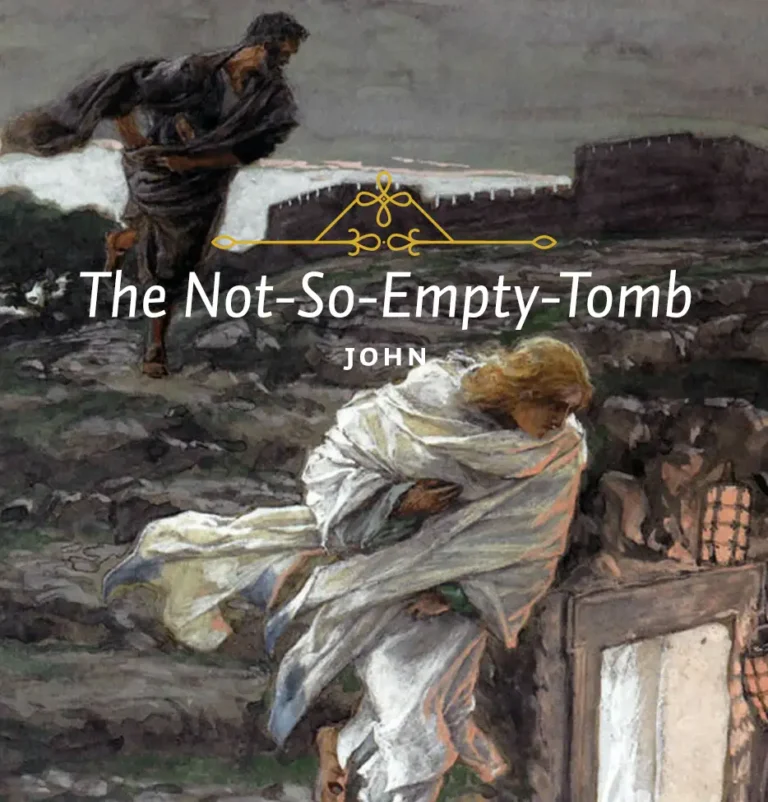
One of the great historical evidences of the resurrection of Jesus Christ is the fact of the empty tomb. But the remarkable and quite startling fact is that when Peter and John arrived at the tomb on the first Easter morning it was not quite empty. That’s right, the tomb on Easter morning was not quite empty. The body of Jesus was gone, but something was still there. The graveclothes remained behind. And the Bible suggests that there was something about them so striking that John at least saw them and believed in Jesus’ resurrection.
Mary meanwhile found the two chief disciples Peter and John, presumably in John’s house where the beloved disciple had taken Mary, Jesus’ mother. The two disciples immediately started for the tomb, running and leaving Mary far behind. John was the younger man. Consequently, he arrived at the tomb first, stooped to look through the narrow aperture, and saw the graveclothes.
Now what would we have seen had we been there at the moment at which Jesus was raised from the dead? Would we have seen Jesus stir, open His eyes, sit up, and begin to struggle out of the bandages? Is this what we would have seen? Not at all. That would have been a resuscitation, not a resurrection. It would have been the same as if He had recovered from a swoon. Jesus would have been raised in a natural body rather than a spiritual body, and that was not the case at all.
At this point Peter arrived and went into the sepulchre. Undoubtedly Peter saw what John had seen, but in addition he was struck by something else. The cloth that had been around the head was not with the other clothes, it was lying in a place by itself (v. 7).
The second lesson from this story is this. The experiences of Peter and John at the tomb also indicate that the body of the Lord was glorified. It was sown a natural body and was raised a spiritual body. And in this body Jesus lives, seated at the right hand of God where He waits in glory, interceding for His own until the moment when He will return again in judgment.
When Jesus died, the faith of His disciples died. There was much about Jesus that they didn’t understand, but what they did understand, they believed and they followed Him because of this. For the three years they were with Him, He was their life. Where He went, they went. What He said, they heard. What He instructed, they tried to obey. Then all of a sudden, even though He had warned them of it, He was taken away, tried and crucified. And they were utterly despondent. So you see, in a sense we can say that when Jesus died, His disciples died too.
Now if Thomas is a great example of the death of faith, the Emmaus disciples, whom I identify as Cleopas and his wife Mary, are great examples of the death of hope. They had been in Jerusalem during the days of the Passover and had hoped that Jesus was the Messiah who would usher in His kingdom. They had heard that certain women whom they knew had gone to the tomb and had returned saying that Jesus had risen from the dead. Yet so far were they from believing in a resurrection, so far were they from having any Christian hope whatsoever, that they didn’t even bother to go to the tomb to investigate themselves. It was done, and so they started out for their home in Emmaus.
We don’t know a whole lot about Mary Magdalene. We’re told in Luke 8 that Jesus had done a mighty work of grace in her life by casting out seven demons. We know that she was one of the women who ministered to Jesus and the disciples. But that’s about all we know until we come to the activities during this last week of Christ’s life.
Now when the women arrived at the tomb with their spices, it suited their purpose to have the stone removed, but it wasn’t what they were expecting. They were confused and asked each other what they should do. And they decided that Peter and John should be told. Either they appointed Mary to the task, or Mary volunteered. So she’s the one who started off to find the disciples to give them the message.
What happened in that instance was the resurrection of Mary. She, no less than the others, had experienced the death of faith and the death of hope. But when the living Lord spoke her name and thereby revealed Himself to her, her faith, which had died, came leaping from its grave, and her hope, which had evaporated, gathered again around the person of her Lord.
One of the great accounts of the appearances of the Lord Jesus Christ to His disciples following the resurrection is His appearance to the two Emmaus disciples recorded in Luke 24. It is an interesting story for a number of reasons, and one is that Jesus preached a sermon on that occasion. It is referred to in verse 27: “And beginning with Moses and all the Prophets, he explained to them what was said in all the Scriptures concerning himself.”
Today we look at some of the texts Jesus must have used in His sermon, which we discussed yesterday. An obvious place to begin is with Peter’s speech at Pentecost found in Acts 2. Peter used three texts in that message. The first was about Pentecost itself. It was from Joel—the prophecy that in the last days, God was going to pour out His Spirit upon all flesh (Joel 2:28-32; see Acts 2:17-21). Peter explained that Joel’s words were being fulfilled right then in the sight and hearing of the people. Then he went on to preach about Jesus. To do that he drew on two more texts from the Old Testament.
In the fourth chapter of Acts we have another of Peter’s sermons. Here he has been called before the Sanhedrin (the highest council of the ancient Jews), and he is defending himself and his teaching. We have a relatively short record of this sermon in verses 8-12, but in the midst of it we have another important Old Testament text applied to Jesus. It is Psalm 118:22, which Peter cites, saying, “The stone you builders rejected …has become the capstone” (Acts 4:11).
In the eighth chapter of Acts, we have another suggestive text. Here Philip has been sent to the Ethiopian eunuch. When Philip finds him, he is reading from a manuscript he acquired in Jerusalem. It turns out that it is Isaiah, and the portion from which he is reading is Isaiah 53: “He was led like a sheep to the slaughter, and as a lamb before the shearer is silent, so he did not open his mouth. In his humiliation he was deprived of justice. Who can speak of his descendants? For his life was taken from the earth” (Acts 8:32-33).
I say as we end this week of Easter readings that I do not know how much of what I have presented this week is what the Lord preached that day on His walk from Jerusalem to Emmaus. But it was a long trip. It would have taken several hours. And I suppose, therefore, that Jesus preached not only what I have tried to explain here, but also a great deal more besides. What I am certain of is this: The Lord preached the Gospel from the Old Testament.

I believe that the road to Emmaus is a road that must be walked, in one sense, by everyone who would become a Christian, or would become a better Christian. And it is in that light that I would like us to study it. The walk started out in disbelief and sadness. It ended in joy, excitement, love, and true devotion. The same can happen to each one of us.
The morning after the Saturday Sabbath then came. Mary went to the tomb to anoint the body with the other women, leaving Cleopas to get their things together. She saw the angels, returned to tell Cleopas about it, and then—and now look how utterly remarkable this is—joined him to preparing to leave. So far from her thinking was any idea of the literal truth of Christ’s bodily resurrection!
What is it that accounts for a belief in the resurrection on the part of Christ’s disciples? The answer is nothing but the resurrection itself! If we cannot account for the belief of the disciples in that way, we are faced with one of the greatest enigmas in world history.
When Jesus began to open the Scriptures to Cleopas and Mary, He initiated the first of three openings that are mentioned in this chapter. He opened the Scriptures; He opened their eyes; and He opened their understanding. These are so significant that they would make an outline for a study all by themselves.
Now there is a great deal more to the story of Cleopas and Mary because of their meeting with the Lord Jesus Christ. For each of these three openings had an important consequence in their lives. And these three results should also occur for us when our Bibles, eyes, and minds are opened.

Why is the resurrection of Jesus Christ the best news the world has ever heard? First, the resurrection of Jesus Christ is good news because it is true.

Next there is the evidence of the empty tomb, coupled with the evidence of the moved stone and the undisturbed graveclothes. How are we to account for these things? Some have imagined that either Joseph of Arimathea or the Roman or Jewish authorities moved the body. But not only was there no reason for this to have been done—it would have involved violating the officially sealed tomb—it is also inconceivable that the true circumstances would not have been revealed later after the disciples had appeared in Jerusalem to proclaim their belief in Christ’s resurrection.
Second, the resurrection of Jesus Christ is good news because it came after an apparent defeat. A victory is always good news. But news of victory after news that a battle has apparently been lost is even better.
Second, the resurrection of Jesus Christ proves the deity of our Lord. When He lived upon earth Jesus claimed to be equal to God and that God, this same God, would raise Him from the dead three days after His execution by the Roman authorities. If He was wrong in this, His claim was either the raving of a deranged man or else blasphemy. If he was right, the resurrection would be God’s way of substantiating the claim.
We may be weak and utterly helpless, unable to resist temptation for a single minute. But He is strong, and He lives to give help and deliverance in every moment of our days. Victory isn’t a question of my strength, but of His power. His power is what I need.

I do not think I need to say a great deal about the importance of this chapter as concerning the resurrection. Next to the resurrection accounts as we find them in each of the four gospels, this chapter is of the greatest importance. What I have discovered to be quite interesting, however, as I have studied it, is that it deals with what we would consider a depressing subject as much or even more so than it deals with the glorious theme of the resurrection. I am talking about death, of course, and the two are connected because it is only as we understand the significance and the horror of death that we understand the importance and glory of the resurrection.
And may I say something else? Death, if you understand it spiritually, is not only an enemy, it is, secondly, also the ultimate enemy, the greatest enemy there is. I think we sense this in our fear of death. We are afraid of death, even though death is transformed for Christians and fear is changed in some sense.
When the Lord Jesus Christ transforms us, He saves us in spirit and soul so that we have a new spirit and a new soul, and by means of death are taken into the presence of Himself. And then at our resurrection He saves us in body also. It becomes, not just a spiritual salvation, not just a soul salvation, but a whole salvation.
Fourth, I want you to see not only that death is an enemy, not only is death the ultimate enemy, and not only is there an ultimate victory over death for us. But I also want you to see that there is a present victory now because the resurrection of the Lord transformed even the kind of death that we know now in our own time and in our own existence and experience.
But at the same time, Jesus’ death is not just a literal death; it is also a literal resurrection. A real resurrection with a real body and a real person standing there that they could handle and touch and furthermore the kind of person who could eat broiled fish to demonstrate the reality. It was no ghost.
There are many facts in life that we are called upon to remember—appointments, vital pieces of information, names of acquaintances, even incidents from the past that are supposed to have significance. “Remember the Alamo” was a rallying cry to Texans at the time of the war with Mexico. “Remember the Maine” served the same purpose at the time of the Spanish American War, following the sinking of the USS Maine in Havana harbor in 1898. In World War II the saying was “Remember Pearl Harbor.” The interesting fact about these sayings is that each refers to a defeat. The saying that I want to take you to today is different and is also more important, for it is a challenge to remember a victory.
In yesterday’s study we said that people need a simple Gospel, not a simplistic Gospel—which we defined as one that is superficial and does not grapple with the deepest problems people have. But when I am talking about a “simple” Gospel, that is something else. It is a gospel that is simple because it brings simplicity to areas that would be hopelessly confusing without it.
Second, we should remember the resurrection because so long as we remember it, we will always have a supernatural Gospel.
Third, we are to remember the resurrection because so long as we remember it, we will always have a scriptural Gospel. This means that our faith will not be a novelty. Instead, we will have a faith linked—as all true faith must be linked—to God’s great and eternal purposes in human history.
Finally, we are to remember the resurrection of Jesus Christ because if we do remember it, we will always have a satisfying Gospel. The truth of the resurrection of Jesus Christ satisfies. There is so much in life that is not satisfying. In some cases we may be satisfied for a time. But the pleasures soon pale and the satisfaction fades.
Can you imagine how these exact words must have been impressed on the minds of these women? They could never forget them. Remember, they had come to the tomb on that early Easter morning, certainly not expecting what they found. They were preoccupied with one thing, and that was to anoint Jesus’ body with the spices they had bought.
Or again, there was the edict of Rome. The tomb had been sealed by Pilate’s order. The soldiers were stationed at the tomb in order to guard it. Now, something had happened: the stone had been removed, and that meant that the seal had been broken, and Rome had been disobeyed. The women might have said, “Oh, but Rome forbids us, we can’t come closer. We can’t look in.” They might have failed to come for that reason.
The third reason we should come and see the tomb is that we might be reminded that we also will lie there. Unless the Lord Jesus Christ comes for His own before we die, we too must die. There is a time when we will be separated from all that we know now. We will leave friends and loved ones. We’ll leave all our material possessions; we’ll leave all that we know behind. So we look to the tomb and we say, “What does this have to teach us of our mortality?” It teaches us that we are mortals and that there is a life beyond for which we must prepare.
Now we’ve looked at two of the words of the angel’s message. We’ve looked at the invitation to come and the imperative to see. We’ve seen some of what that implies for us. The third word is “go” (v. 7). It’s a reminder that, blessed as it may be to stay near the tomb, nevertheless there is still work to do and we should not linger around the tomb.
This leads me to the fourth and last point, which is the word “tell.” There’s a wonderful sequence to these four words. If we come, if we see that the tomb is empty, if we are commissioned to go, then it is inevitable that we must have a message to tell. Good news must be told. If we don’t tell it, we don’t really recognize how good it really is.
In nearly every case where the Lord Jesus Christ appeared to someone after His resurrection, He gave them instructions to take the message to someone else. For instance, when He appeared to Mary Magdelene in the garden, Mary didn’t recognize Jesus at first. But when He spoke her name, she recognized His voice, responded to Him, and then He gave her this word of instruction: “I am going to my Father and your Father, to my God and your God. Now go quickly and tell my disciples.”
Now as we look at this commission, we see three parts to it. First, there is an announcement of Christ’s authority, which we find in verse 18: “All authority is given unto me in heaven and in earth.” Second, we find a command: “Go ye therefore and teach [make disciples of] all nations, baptizing them in the name of the Father and of the Son and of the Holy Ghost, teaching them to observe all things whatsoever I have commanded you” (vv. 19-20). And then third, we have a great promise: “Lo, I am with you alway, even unto the end of the world” (v. 20).
Jesus is the King of kings and the Lord of lords. His authority transcends all other authority. Now there are other legitimate authorities as well and we’re instructed to recognize them. There is the authority of the state. There is the authority of parents. There is the authority of church officers. These are all legitimate authorities. But over all of these authorities is the authority of the Lord Jesus Christ, and it is on the basis of that authority over us as individuals within the church that He makes the Great Commission which follows.
It’s easy to look back to the resurrection on Easter Sunday and say how marvelous it is that Jesus rose from the dead two thousand years ago, and then go home to your dinner and leave it at that. But if Jesus rose, and if He is the Lord that His resurrection declares Him to be, this is the Lord who tells you to go into the world and to tell others that He is risen from the dead. Furthermore, Jesus doesn’t make the Great Commission vague, because He tells us how to do it.
Proper evangelism, proper missionary work, proper Christian activity is to go out with the Gospel, win men and women to Christ, and bring them into the fellowship of the church where they are then taught the things that are found in the Scripture. Christianity is a full-orbed doctrine and approach to life which we grow into increasingly as we share and study Christ’s Word.