
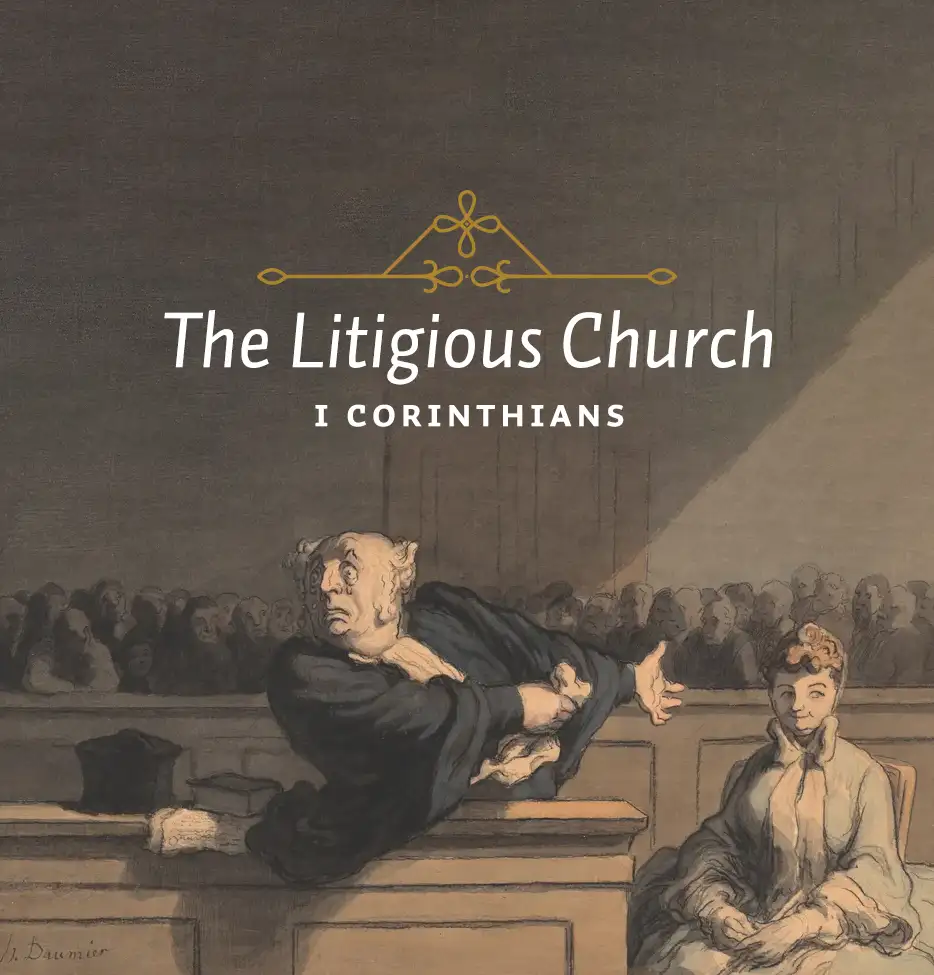
That brings us to chapter 6, where as I said we come to this third matter of litigation. Paul does not supply the details of the situation, since it would have been known by both Paul and the Corinthian church. But apparently what was happening is that Christians in the church were going to court against one another. Now we have to treat this in a balanced way. You have to be very careful here in handling this passage so as not to get the idea that somehow the courts or civil government is utterly illegitimate. The Bible does not teach that. For example, even Paul himself, when he was arrested through the hostility of the Jewish leaders in Jerusalem and brought before the Roman courts, did not hesitate at all to appeal to Caesar because he was a Roman citizen. Paul recognized that God has set up government, and it is a blessing when it functions properly.
But while there is a legitimate role for the courts, from 1 Corinthians 6 we see that it is quite wrong when such legal appeal takes place in the Christian community against one another. There are several things that were wrong. Paul deals with this problem by talking about the item that was the most evident, and then he traces it back to its cause. Then he takes that cause and traces it to a still further cause. In order to see how he does this, we will start with verse 8 and work in reverse.
In verse 8 Paul says, “Instead, you yourselves cheat and do wrong, and you do this to your brothers.” That is the fundamental problem. You had men and women within the church of Jesus Christ who were cheating other members of their church. That is why Paul continues in verses 9-11 as he does, when he explains the nature and characteristics of those who will inherit the kingdom of heaven as over against those who will not. Paul tells the Corinthians that before their conversion some of them behaved in these unrighteous ways, including cheating others. But now they are different, and they cannot live as they once did.
A second fault came from this cheating, which is that Christians were fighting one another. Disputes arose that eventually spilled over into formal, legal contests. This then exposed the third problem of Christians appealing to the secular authorities for justice, rather than to someone from within the Christian community. This wrong is what Paul addresses first in chapter 6, and he seems to find it especially offensive. If any of God’s people has a dispute with another, dare he take it before the ungodly for judgment instead of before the saints?
As Paul analyzes all of this, he proposes two solutions. The first solution is that, if at all possible, Christians should find someone within the church who is capable of judging in such matters. And they do not have to be especially competent in legal affairs. Paul says in verse 4 that even one of “little account” in the church is better than a secular judge. It is bad enough that there is the need for such mediation between Christians at all. But if it somehow comes to that, at least handle it decently by keeping it within the Christian community, because it is a disgraceful thing when the secular authorities are asked to settle the dispute.
The second solution that Paul proposes is more radical than the first. What he says in this area is found in verse 7: “The very fact that you have lawsuits among you means you have been completely defeated already. Why not rather be wronged? Why not rather be cheated?” Paul is saying that if you eventually find it impossible to work it out, isn’t it better, for the sake of the testimony of Jesus Christ, to allow yourself to be cheated by someone who is doing that rather than to bring disgrace upon Christ’s name?