
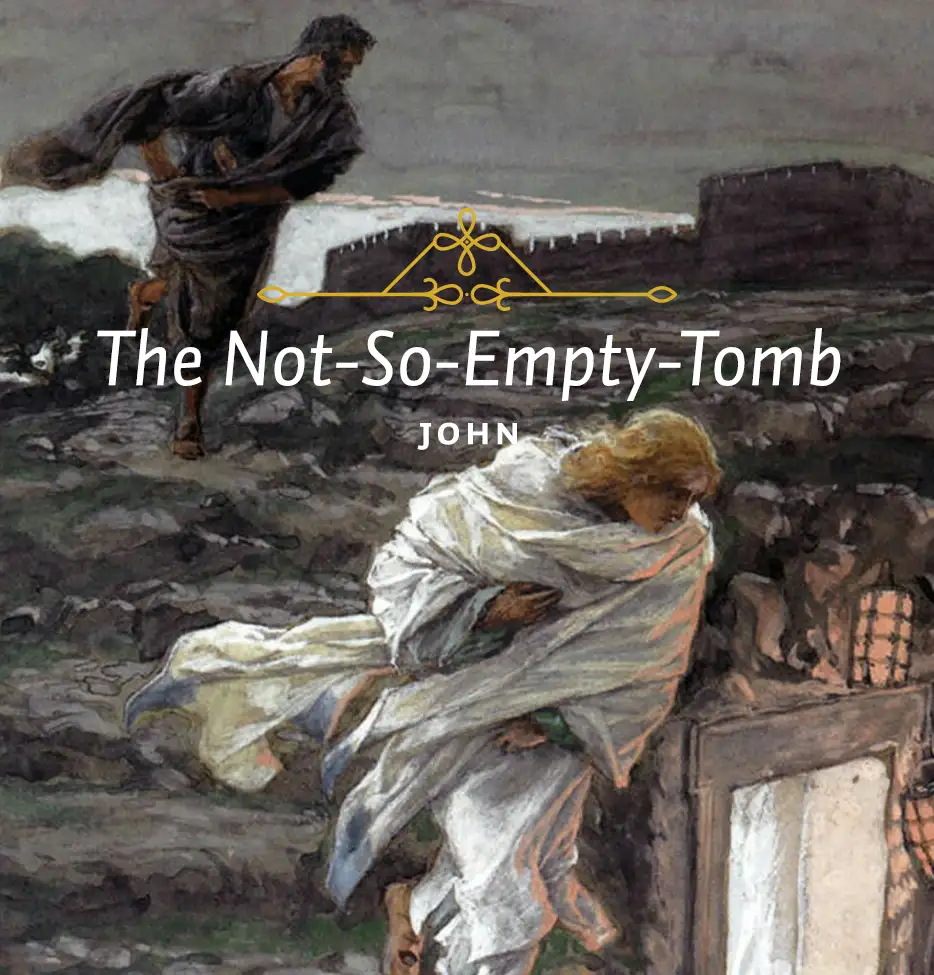
At this point Peter arrived and went into the sepulchre. Undoubtedly Peter saw what John had seen, but in addition he was struck by something else. The cloth that had been around the head was not with the other clothes, it was lying in a place by itself (v. 7).
And what was more striking, it had retained a circular shape. John says that it was “wrapped together.” We might say that it was “twirled about itself.” And there was a space between it and the clothes that had enveloped the body. The narrative says, “Then Simon Peter came, following him, and he went into the tomb; he saw the linen cloths lying, and the napkin, which had been on his head, not lying with the linen cloths, but rolled up in a place by itself” (vv. 6-7).
Finally, John too entered the sepulchre and saw what Peter saw. And when he saw it he believed. Now what did John believe? I imagine that he might have explained it to Peter like this: “Don’t you see, Peter, that no one has moved the body or disturbed the graveclothes. They are lying exactly as Nicodemus and Joseph of Arimathea left them on the eve of the Sabbath. Yet the body is gone. It has not been stolen. It has not been moved. Clearly it must have passed through the clothes, leaving them as we see them now. Jesus must be risen. He is risen indeed.” John Stott says, “A glance at these grave clothes proved the reality, and indicated the nature, of the resurrection.”1
How foolish in the light of such evidence are the non-Christian explanations of the events of Easter morning. Some critics have taught that the body of Jesus was stolen. But in that case the presence of the graveclothes is inexplicable. They would have been removed along with the body. Others have taught that Jesus revived in the tomb and escaped after having unwound the linen bands. But in that case the linen would have been displaced. Even if we can imagine that Jesus replaced them where they had been and somehow moved the stone, there is still a problem with the spices, for these would have been scattered about the tomb. And of this there is not the slightest suggestion in the gospel. No, none of these explanations will do. The disciples saw everything in order, but the body of Jesus was gone. He had indeed been raised, and had been raised incorruptible in a resurrection body.
There are just a few lessons that arise out of this story, and I want to look at them briefly. The first lesson is that God the Father has provided perfectly adequate evidence of the resurrection of Jesus Christ from the dead. The evidence consists of the claims of those who saw Jesus between the day of His resurrection and the day of His ascension into heaven, the empty tomb, the changed character of the disciples, the authenticity of the records, and the evidence of the undisturbed burial garments. The evidence is there, and the evidence of the graveclothes alone was sufficient to quicken faith in John. If men fail to believe, it is because they will not believe. It is not because the evidence is lacking. Let us never forget this truth. God does not expect men to believe without evidence; He has given the evidence. He even gives His Spirit to help men understand it. When men do not believe, assuming that they have looked at the evidence, it is because they do not want to surrender their lives to Christ and acknowledge Him as Lord. If Jesus should return today, millions would reject Him. If He should make the claims that He made while here before, there are many who would condemn Him to death. And if Jesus should rise again from the dead, there are men who would laugh at Him and call it trickery.
At the same time, however, there are those who do believe. They have seen the evidence and have responded to it as God has enabled them to by His Spirit. These are comforted to know that their faith rests, not upon wishful thinking, but upon God’s visible activity in history.
1John R. W. Stott, Basic Christianity (Grand Rapids, MI: Eerdmans Publishing Company, 1958), 55.