
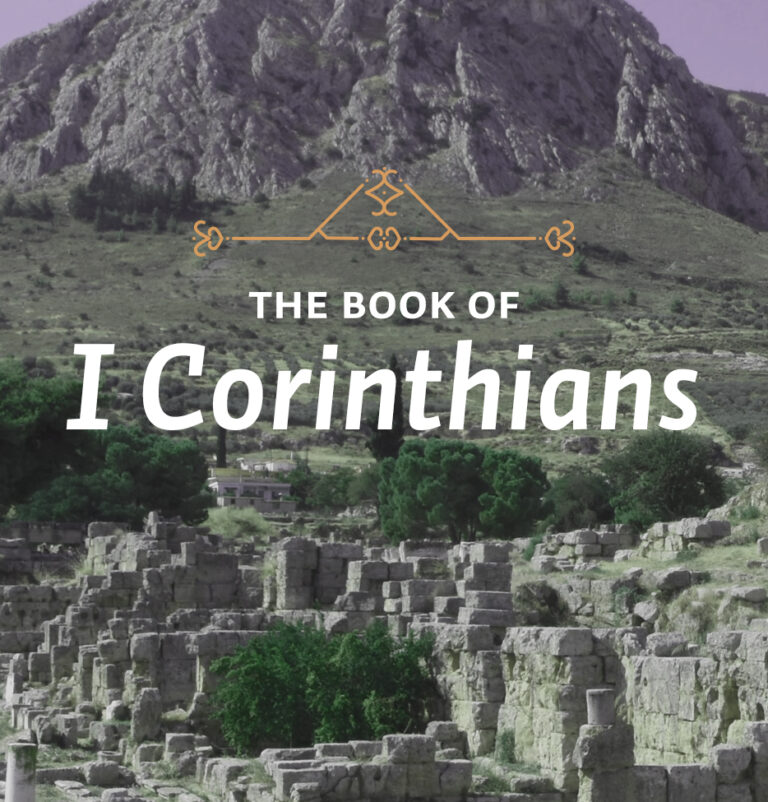
Wisdom

Not Many Wise – Part One

 The believers at Corinth are commended by the apostle Paul in the first seventeen verses of chapter 1 for what they have and are in Christ. But in practical terms, they were rent with all kinds of divisions and personal loyalties. As we read on in the letter, their troubles unfold.

Keep Reading

Not Many Wise – Part Two

 Yesterday we began to look at the foolishness of the world. Today we will look at specific examples of such folly. There should be a connection between wisdom and results, and this is precisely the point at which the world’s wisdom, which is foolishness to God, is found wanting.

Keep Reading

Not Many Wise – Part Three

 Yesterday’s lesson mentioned Carl Sagan’s book and television series on evolution, Cosmos. Today I want to point out the great errors in Sagan’s approach to things. Let me suggest a few. The first is the error of supposing that all there is can be observed by the human eye. I cannot see anything spiritual, but I can see planets, and atoms, and the relationships between those things.

Keep Reading

Not Many Wise – Part Four

 Theories will come and go. Today’s theory about psychology, or sociology, or science is very quickly superseded by another theory. We know perfectly well how passing all of that is. Yet, there is the Gospel, which endures, which is based on the very nature of God (who is reality himself) and which changes not. The world says, “Oh, all that is foolishness.”

Keep Reading

Not Many Wise – Part Five

 Yesterday we looked at how the Jews, the Greeks, and the Romans were all offended by Paul’s message of the cross. So what did Paul do when faced with this opposition? When he preached to the Romans, he preached Christ crucified in weakness, but in the power of God. When he preached to the Jews, he preached Christ, who came not as a sign, but to die and give his life as a ransom for many in the power of God.

Keep Reading
Not Many Wise

Monday: The Failure of Human Wisdom

With verse 18 of chapter 1 we come to the first major treatment of a theme that Paul considers in the book, the theme of wisdom and foolishness, the wisdom of God contrasted with the foolishness of men. It is a major section because Paul deals with that not only in the remainder of chapter 1 but throughout chapter 2. And it is not until chapter 3 that he gets back to the matter of the divisions among the church at Corinth that he mentioned in the introduction.

Keep Reading
Not Many Wise

Tuesday: Human Wisdom’s Folly

I suppose there is no greater example of the folly of this world in its profession of wisdom than in the great trust that is put in the theory of evolution. What is really foolish about
evolution is the inevitable attempt to make what is essentially a theory into a kind of religion by using it to try to explain how things came to be, when evolution cannot possibly explain it.

Keep Reading
Not Many Wise

Wednesday: The “Foolishness of God”

A third error in Carl Sagan’s view of the universe is to suppose that somehow in that kind of a closed, materialistic system which excludes God, moral purpose and moral obligation can come about. If I am the accident of the universe, why do I owe anybody anything? I do not. I am not answerable to anything. How am I answerable to an impersonal universe? And yet, Sagan cannot live with that kind of a universe, so he projects moral values into it, apparently not realizing that the impersonal cosmos is not able to account for morality.

Keep Reading
Not Many Wise

Thursday: How God Works

We come now to the third section, where Paul begins to think about how God works. It is not only that God has demonstrated His wisdom at the cross in what Jesus Christ achieved there;
God also demonstrates His wisdom by choosing the foolish people of this world to come to Christ, not the wise.

Keep Reading
Not Many Wise

Friday: Sharing the Gospel with Others

That brings us to the final point that Paul develops in the first verses of chapter 2, which is the implication of all this for the preaching of the Gospel. Paul understood that the power of God was to be found not in the power of men nor in the wisdom of men, but in the simple Gospel of the preaching of the cross. That is precisely why Paul was so determined to preach the message that he did.

Keep Reading

Subscribe to the Think & Act Biblically Devotional

Alliance of Confessional Evangelicals

About the Alliance

The Alliance is a coalition of believers who hold to the historic creeds and confessions of the Reformed faith and proclaim biblical doctrine in order to foster a Reformed awakening in today’s Church.

Canadian Donors

Canadian Committee of The Bible Study Hour
PO Box 24087, RPO Josephine
North Bay, ON, P1B 0C7