
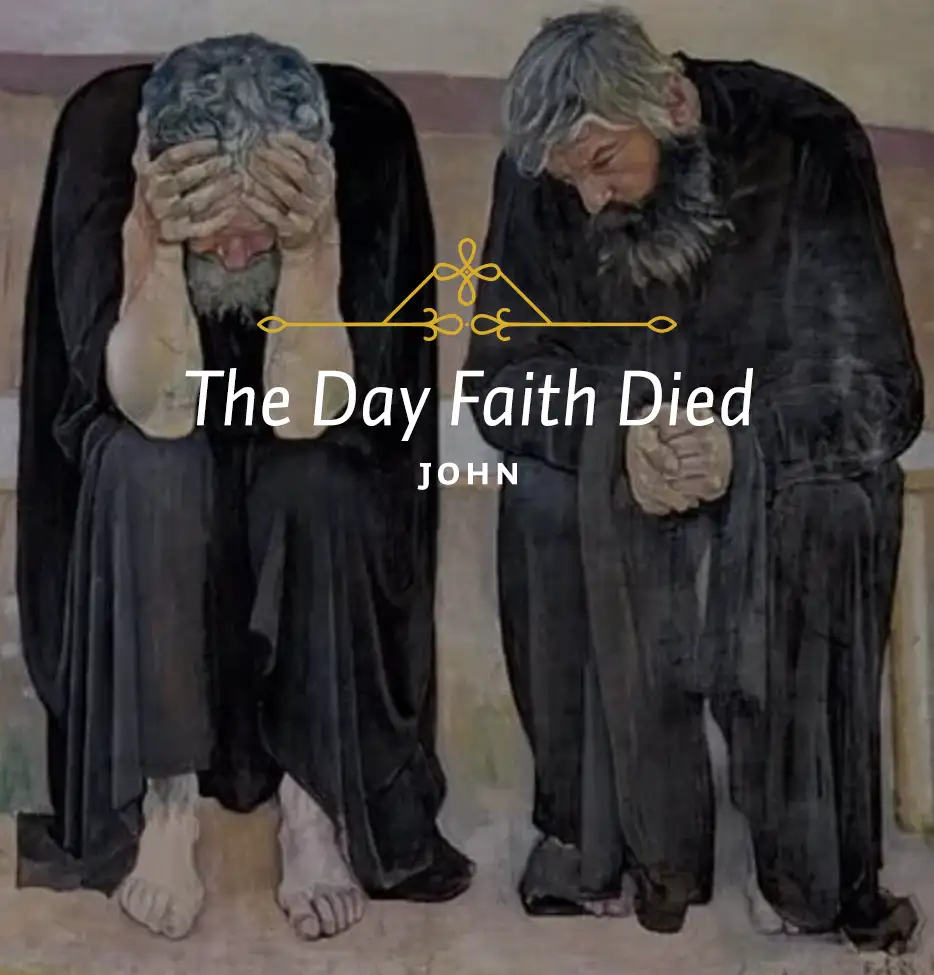
When Jesus died, the faith of His disciples died. There was much about Jesus that they didn’t understand, but what they did understand, they believed and they followed Him because of this. For the three years they were with Him, He was their life. Where He went, they went. What He said, they heard. What He instructed, they tried to obey. Then all of a sudden, even though He had warned them of it, He was taken away, tried and crucified. And they were utterly despondent. So you see, in a sense we can say that when Jesus died, His disciples died too.
Now this was true of all of them. And so after Christ was crucified, they immediately began to scatter back to where they had been previously. Cleopas and Mary went back to their village. The women went back home. The others would eventually go back to Galilee. All that they had heard and seen was over now. Faith had died.
Now the death of faith is nowhere better illustrated than in the case of the disciple Thomas. We don’t know a great deal about him because he’s not mentioned many times in the New Testament, but what we do know indicates that he possessed a very sober outlook on life.
On one occasion, when Jesus and the disciples had received a message that their friend Lazarus was sick and Jesus had determined to go up to Bethany in the area of Jerusalem, Thomas was present. And Thomas understood what it meant to go back to Jerusalem. That’s where Christ’s enemies were. If His enemies were there, you know danger was there. Thomas knew the threats that had been made against Christ’s life, but he loved Christ and he was going to be with Him to the end, albeit grimly. So he said, “Let us also go, that we may die with him” (John 11:16).
Later, in the upper room when Jesus said, “Whither I go ye know, and the way ye know” (John 14:4), Thomas answered that he didn’t know the way: “Lord, we do not know where you’re going and therefore how can we know the way?” He was a man of a very sober faith that looked at the evidence, and so we’re not surprised to find that a week after the resurrection, even though the other disciples had come to Thomas and had told him that they had seen the Lord, he declared he would not believe it. “Except I shall see in his hands the print of the nails, and put my finger into the print of the nails, and thrust my hand into his side, I will not believe” (John 20:25).
We call Thomas “Doubting Thomas,” but strictly speaking that’s an inaccurate designation, because this isn’t doubt here as he’s told about the resurrection of Christ by the other disciples. Alexander Maclaren said quite rightly, “Flat, frank, dogged disbelief and not hesitation or doubt, was his attitude.”1 Thomas, like so many of us, said, “I do not see evidence for it and I will not believe until I see the evidence myself.”
Now we wouldn’t say just because he was very sober minded about things that he never had faith in Jesus enough to follow Him for three years. But the crucifixion had ended it, you see. It was done and so Thomas said that, so far as he was concerned, it was over. I can even hear him say, although he didn’t say the words outright, “Jesus should have listened to me. I knew what would happen. I said that if He went up to Jerusalem He would be killed. He went. He was killed. And now that it’s over, I’m going home.”
1Alexander Maclaren, Expositions of Holy Scripture, vol. 7, Gospel of John (Grand Rapids, MI: Eerdmans, 1959), Part 3, 321.