
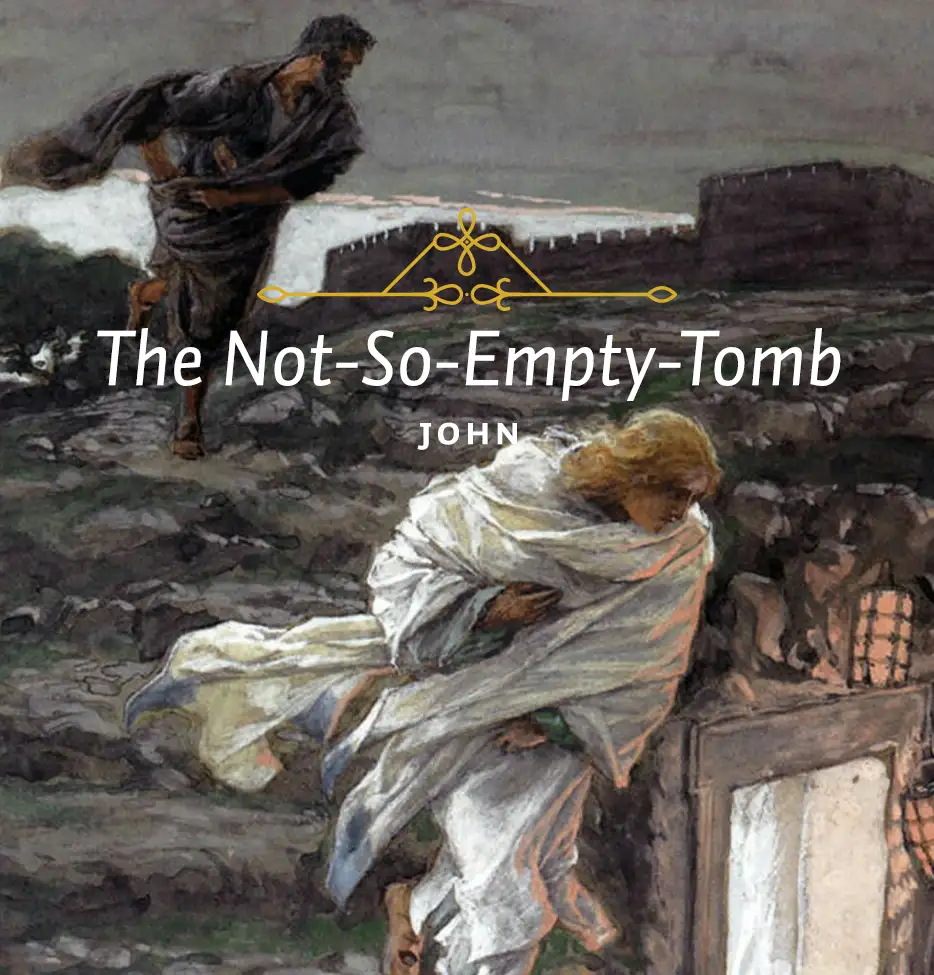
One of the great historical evidences of the resurrection of Jesus Christ is the fact of the empty tomb. But the remarkable and quite startling fact is that when Peter and John arrived at the tomb on the first Easter morning it was not quite empty. That’s right, the tomb on Easter morning was not quite empty. The body of Jesus was gone, but something was still there. The graveclothes remained behind. And the Bible suggests that there was something about them so striking that John at least saw them and believed in Jesus’ resurrection.
This is quite significant, for it marks the first time there was any indication of belief by one of the disciples. During the last century, a well-known French critic of the gospels, Ernest Renan, argued that Christian faith in the resurrection was the result of the rumors spread by Mary Magdalene who had suffered a hallucination, thinking she had seen Jesus.
But this could not be. Mary suffered no hallucination. The last thing in the world she ever expected was the resurrection of her Lord. Moreover, John testifies that he believed some time before Mary even returned to the tomb and had her meeting with Jesus in the garden.
Let us look at the sequence of events.
Now the time element is of great interest here. For it is valuable background to the experiences of Peter and John at the tomb. Critics have made much of the so-called discrepancies in the gospel accounts, but there are no discrepancies when the accounts are correctly understood. And it is no trouble at all to reconcile them.
Jesus had been crucified either on Friday (as the Church has generally believed) or else on Thursday (which is less widely held but which seems to fit the evidence). At all events, Jesus lay in the tomb until the resurrection which certainly took place long before dawn on Sunday morning. At this point the women came to the tomb from Jerusalem bearing spices to anoint His body.
There were at least four women and probably more. Matthew says that the group included Mary Magdalene and the other Mary; that is, Mary the mother of James. Mark adds that Salome was present. Luke says that Joanna was also along, and others. These women started out while it was still dark and arrived at the tomb in the early dawn while it was still difficult to distinguish objects.
On reaching the tomb the women were astonished to find the stone removed from the entrance. We must imagine them standing about, afraid to go too close, wondering what had happened. Who has moved the stone? Has the tomb been pilfered? Has the body of Jesus been stolen? Has Joseph of Arimatheia removed it to another place? What were they to do? At last they decided that the disciples of Jesus must be told, and Mary was dispatched to find them. Not one of them imagined that Jesus had been raised from the dead.
After a while it began to grow lighter, and the women grew bolder. They decided to look into the tomb. There they saw the angels. The women were afraid. But an angel said, “Do not be afraid; for I know that you seek Jesus who was crucified. He is not here; for he has risen, as he said. Come, see the place where he lay. Then go quickly and tell his disciples.”