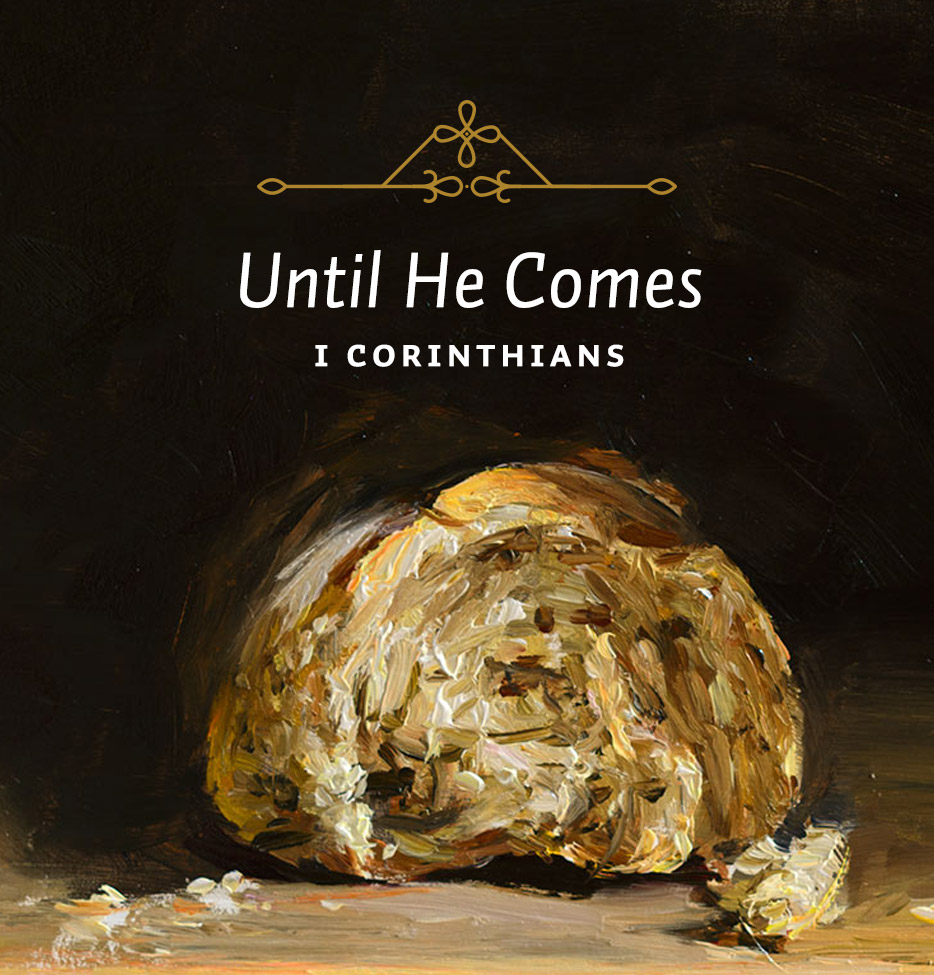
Another problem, which is closely wrapped up with the first and seems to be Paul’s major concern, is that by conducting themselves in that manner they were actually producing divisions among themselves in the very midst of the observance that was supposed to indicate that the church, in all of its diverse parts, was actually one. This is also seen in chapter 10, verse 17, where Paul is speaking of the Lord’s Supper: “Because there is one loaf, we, who are many, are one body, for we all partake of the one loaf.” He said the very way in which they were in the habit of observing the Lord’s Supper, that is, by taking one loaf of bread, breaking it, and distributing it among the many who were there, indicates that the church of Jesus Christ is one. Yet the meal taking place in the context of the Lord’s Supper was creating divisions and contrasts among the church, in addition to the schisms that already existed around particular people and their ministries, as we saw in chapter 1.
Paul, of course, was bothered by all that was going on, and as he writes to them he is not disguising in any measure his displeasure. Earlier in this chapter as he began to talk about worship and whether women were to be coming to worship with their heads covered or not, he begins with a word of praise to them for holding on to the teachings he has passed on. But when he comes to this point of his letter, he begins in verse 17, “In the following directives I have no praise for you, for your meetings do more harm than good.”
The way Paul counters their wrong behavior is to go back and remind them of that which they certainly knew, which were the words of the institution of the Lord’s Supper. Paul did not invent the language used. It was not something that was unique to the church of Corinth. No, Paul says that the message he delivered to them was the same one he himself had received from the Lord. He then goes on to recount how the Lord’s Supper got started in the first place. On that very night that Jesus was betrayed, He gathered together with His disciples for this holy institution. He took bread, broke it, and said to them, “This is my body which is given for you.” He told them to take a piece in remembrance of Him. Then Paul said that in the same way Jesus took the cup and said, “This cup is the cup of the new covenant in my blood, and as often as you drink it, do it in remembrance of me.” As Paul gets to the end of this summation he tells them that whenever they eat of the bread and drink of the cup, they are proclaiming the Lord’s death until He comes (1 Cor. 11:26).
These verses contain three time elements. There is first of all a reference to the past because Paul quotes the Lord Jesus Christ, who says that we are to do this in remembrance of Him—we are to look back to Christ and what He has done for us in His suffering, death, and resurrection. Secondly, there is the future element, for Paul says that whenever you come to the communion table you are declaring the saving benefits of the Lord’s death until He comes again. In other words, in the Lord’s Supper we are looking forward to the future return of Jesus Christ. This leads to the third element, which is the present. We are in between the past event of Jesus’ incarnation and the future event of His return. We are now living in the present on the basis of what He has done. As we live for Him we are to examine our hearts before we partake of the elements in order that we might not eat or drink unworthily, but might begin to grow in grace, which is the reason for which the Lord Jesus Christ instituted the sacrament.
When we look to Christ’s death in the past, we look to it not simply as a tragedy involving the execution of an innocent man and, therefore, a miscarriage of justice. Rather, we look back to the death of Christ as that sacrifice which Jesus made for our sins and which was no accident because it had been planned from before the foundation of the world. That means that before the world was created, God set Jesus Christ aside to be our Savior by His death on the cross. Moreover, it was necessary that He should die, the innocent for the guilty, the Son of God for creatures who had ruined themselves with sin. The cross, then, becomes the focal point of history.