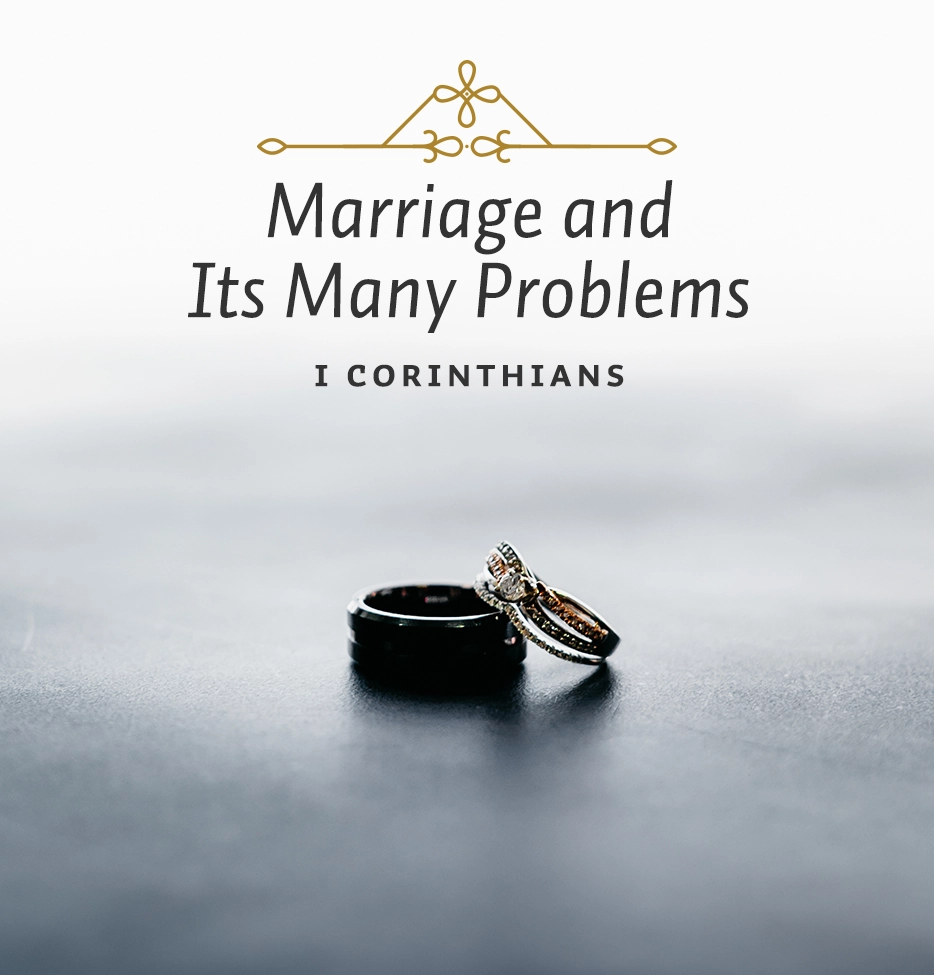
The very last portion of this chapter begins with verse 17. Paul talks about what I would call contentment, and he brings in a number of different illustrations. We should be content to abide in whatever calling God has called us. If God has called you to a married state, be content with that and use it for His glory by making it everything God wants your marriage to be. And if, on the other hand, God has at least to this point in your life called you to a single state, do not try to be married because God’s grace is sufficient also for the single life, and God will bless that, too.
You might say that you do not think you can do that. You want things to be a certain way that are very different from what they currently are. The problem at this point is that of sin, which causes us to focus on what we do not have and think we cannot live a fulfilling and satisfying life without. If you are single, you say to yourself that you cannot be fulfilled in your present state, and that you have got to get married. Or you tell yourself that are not fulfilled in your marriage, and you have to end it and start again. That is not Christianity. That is the sinful nature within which says that you have to put yourself first. But Paul says that you need to break that way of thinking, and to realize that there is no real growth in the Christian life unless you do just that.
What you have to begin with is the will of God and serving Him. You have to recognize that you are not your own, but you have been bought with a price, even the precious blood of Christ. If He calls you to a single life, you should count that all joy to serve Him in a single life. If He calls you to a married life, you should count that all joy to serve in a married life. You need to look at everything from the framework that God is able to use you to bring the fullest measure of blessing in the lives of other people.
Someone will say in response, “Oh, yes, but you don’t understand. You are not in my set of circumstances.” Well, that may be true. It may be that I do not understand. But what we are to do is not to be determined by whether someone else understands or not, or even whether we understand the situation ourselves. What we do is to be determined by what the Word of God says. When we live by that, we find that even if human loves disappoint us, the love of the Lord is sufficient and is able to bear us up.
We have a great hymn that has a wonderful story with it. “O Love That Wilt Not Let Me Go” was written in 1882 by George Matheson. He was engaged to be married to a beautiful girl, and then he had an accident which left him blind. As he lay in the hospital, he was wondering what was going to happen to him in his life and what would happen to him in the relationship. The girl came to see him and told him that she could not spend her life married to a blind man.
Matheson, having not only lost his sight but now also his love, was thrown back upon the love of God. And it was out of that great grief that he wrote this hymn. The one love left him, but the love of God picked him up.
O Love that wilt not let me go, I rest my weary soul in thee;
I give thee back the life I owe, that in thine ocean depths its flow may richer, fuller be.
O Light that follow’st all my way, I yield my flick’ring torch to thee;
my heart restores its borrowed ray, that in thy sunshine’s blaze its day may brighter, fairer be.
O Joy that seekest me through pain, I cannot close my heart to thee;
I trace the rainbow through the rain, and feel the promise is not vain that morn shall tearless be.
O Cross that liftest up my head, I dare not ask to fly from thee;
I lay in dust life’s glory dead, and from the ground there blossoms red life that shall endless be.
That is a great love. It is not the love of a man or the love of a woman. It is the love of God.