At the end of yesterday’s study, we noted how Eastern burials appear to have changed very little over the centuries, providing us with better understanding of the details of Jesus’ own burial.
Luke tells us that when Jesus was approaching the village of Nain earlier in His ministry, He met a funeral procession leaving the city. The only son of a widow had died. Luke says that when Jesus raised him from death two things happened. First, the young man sat up, that is, he was laying upon his back on the bier without a coffin. And second, that at once he began to speak. Hence, the graveclothes did not cover his face.
Separate coverings for the head and body were also used in the burial of Lazarus (John 11:44). We have every reason to believe that Joseph of Arimathea and Nicodemus buried Jesus Christ in a similar manner. The body of Jesus was removed from the cross before the beginning of the Jewish Sabbath, was washed, and was wrapped in linen bands. One hundred pounds of dry spices were carefully inserted into the folds of the linen.
Aloes were a powdered wood like fine sawdust with an aromatic fragrance, and myrrh was a fragrant gum that would be carefully mixed with the powder. Jesus’ body was encased in these. His head, neck and upper shoulders were left bare and a linen cloth was wrapped about the upper part of His head like a turban. The body was then placed within the tomb where it lay until sometime on Saturday night or early Sunday morning.
Now what would we have seen had we been there at the moment at which Jesus was raised from the dead? Would we have seen Jesus stir, open His eyes, sit up, and begin to struggle out of the bandages? Is this what we would have seen? Not at all. That would have been a resuscitation, not a resurrection. It would have been the same as if He had recovered from a swoon. Jesus would have been raised in a natural body rather than a spiritual body, and that was not the case at all.
If we had been present in the tomb at the moment of the resurrection, we would have noticed that all at once the body of Jesus would have seemed to have disappeared. John Stott, the minister of All Souls Church in London, says that the body “would have ‘vaporized’, being transmuted into something new and different and wonderful.”1 It would have passed through the graveclothes, as it was later to pass through closed doors. Latham says that the body had been “exhaled,” passing “into a phase of being like that of Moses and Elias on the Mount.”2 We would only have seen that it was gone.
Now what would have happened? The linen clothes would have subsided once the body was removed because of the weight of the spices that were in them; and they would have been lying undisturbed where the body of Jesus had been. The cloth which surrounded the head, without the weight of spices, might well have retained its concave shape and have lain by itself, separated from the body clothes by the space where the neck and shoulders of the Lord had been.
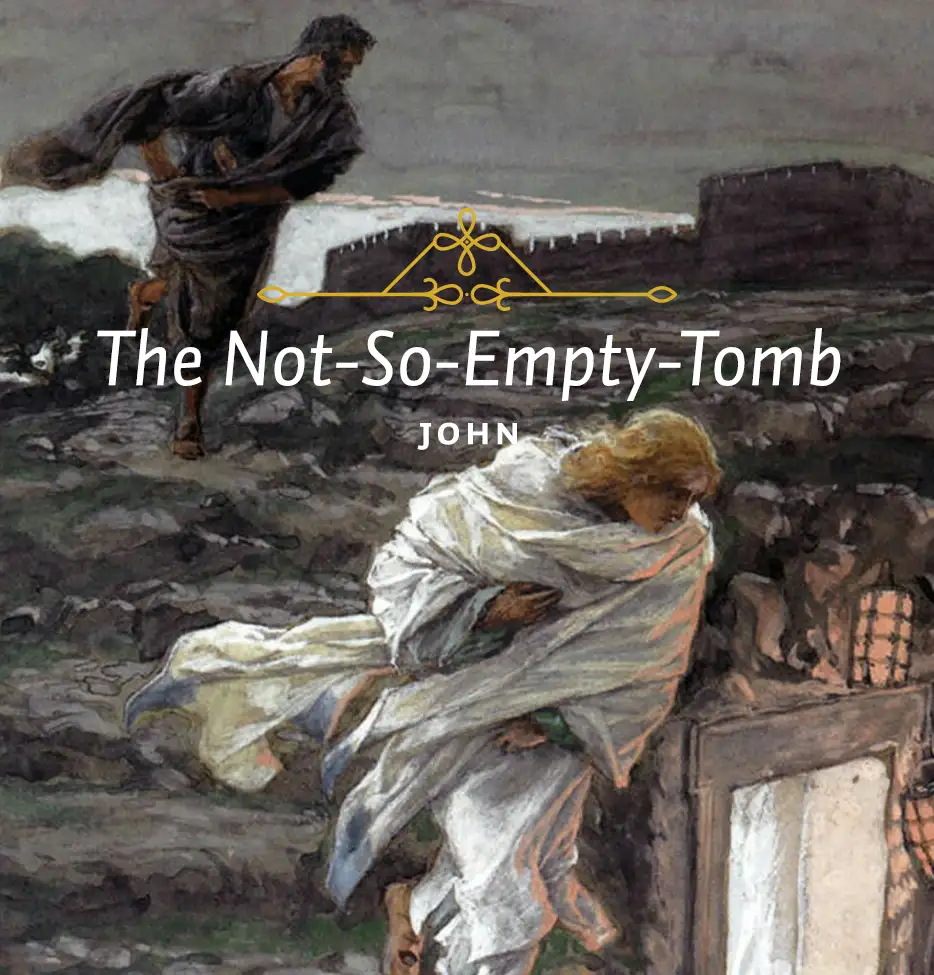
Now, of course, this is exactly what John says that he and Peter saw when they entered the sepulchre. And the eyewitness account reveals it perfectly. John himself was the first at the tomb, and as he reached the open sepulchre in the murky light of early dawn he saw the graveclothes lying there. There was something about them that attracted John’s attention. First, it was significant that they were lying there at all. John emphasizes the fact using the word for “lying” at an emphatic position in the sentence. We might translate the sentence, “He saw, lying there, the graveclothes” (v. 5).
Furthermore, the clothes were undisturbed. The word that John uses (keimena) occurs in the Greek papyri of things that have been carefully placed in order. One document speaks of legal documents saying, “I have not yet obtained the documents, but they are lying collated.” Another speaks of clothes that are “lying [in order] until you send me word.” Certainly John noticed that there had been no disturbance at the tomb.
1John R. W. Stott, Basic Christianity (Grand Rapids, MI: Eerdmans Publishing Company, 1958), 52.
2Henry Latham, The Risen Master (Cambridge: Deighton Bell, 1901), 36, 54.