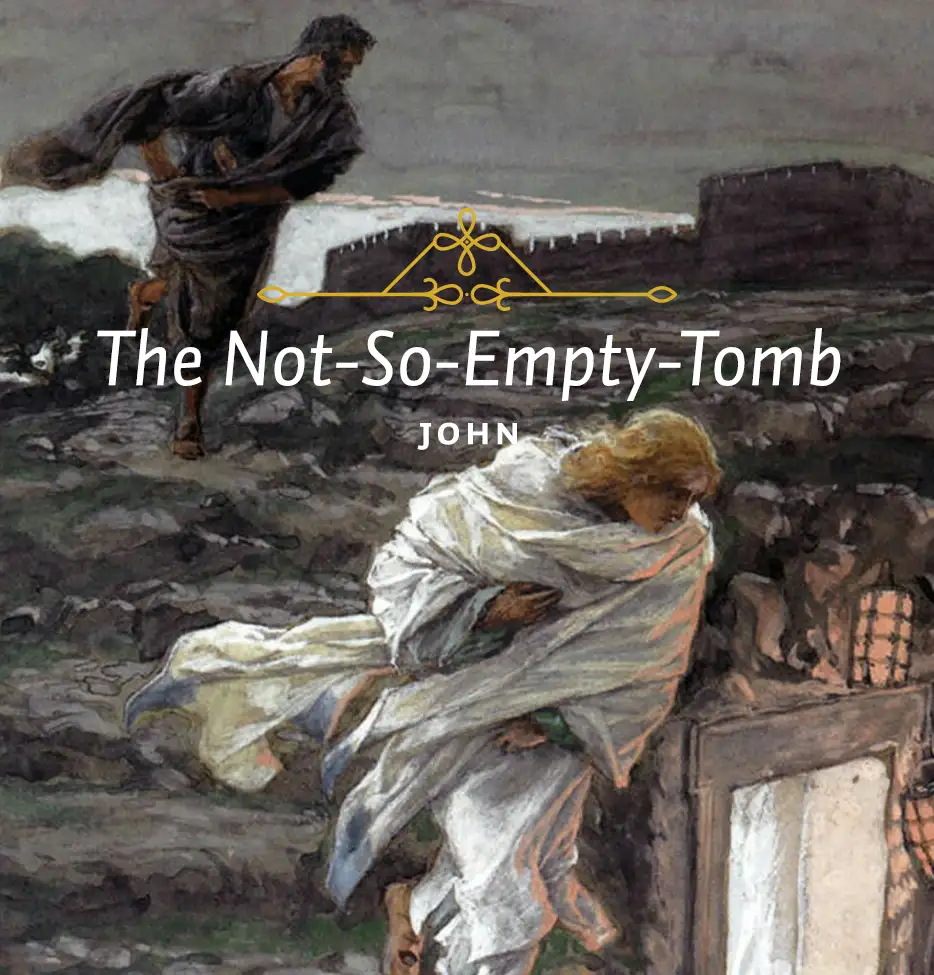
Mary meanwhile found the two chief disciples Peter and John, presumably in John’s house where the beloved disciple had taken Mary, Jesus’ mother. The two disciples immediately started for the tomb, running and leaving Mary far behind. John was the younger man. Consequently, he arrived at the tomb first, stooped to look through the narrow aperture, and saw the graveclothes. Then Peter arrived, out of breath and in a hurry as usual; he brushed John aside and plunged directly into the tomb. The Bible says that when John saw the graveclothes, he saw them only in a cursory manner and from outside the tomb. The Greek uses the most common word for seeing. But when Peter arrived he scrutinized the graveclothes carefully. The Scripture uses a special word (theoreo) for what Peter did, and tells what Peter saw. Peter “went into the tomb; he saw the linen cloths lying, and the napkin, which had been on his head, not lying with the linen cloths, but rolled up in a place by itself.” At this point John entered, saw what Peter had seen, and believed in Jesus’ resurrection.
That was the first moment of belief. In this moment John became the first Christian. It is after this that the first appearances of the risen Lord begin. Jesus appeared first to Mary Magdalene who arrived back at the tomb after John and Peter had returned to the city.
Next He appeared to the women who were then still returning to the city, then to Peter, then to the Emmaus disciples, and finally, later that night, to all of the disciples as they were gathered together in the upper room. All of the disciples who saw the risen Lord believed.
But John believed first. And he did so before he actually saw Jesus. What made him believe? What did he see that convinced him of Jesus’ resurrection?
It is helpful at this point to know something about the modes of Jewish burial. Every society has its distinct modes of burial, and this was as true of ancient cultures as it is today. In Egypt, bodies were embalmed. In Rome and in Greece they were often cremated. But in Palestine they were neither embalmed or cremated. They were wrapped in linen bands that enclosed dry spices and placed face up without a coffin in tombs, generally cut from the rock in the Judean and Galilean hills. Many of these tombs exist today and can be seen by any visitor to Palestine.
Another factor of Jewish burial in ancient times is also of special interest for understanding John’s account of Jesus’ resurrection. In one of the most helpful books about the resurrection of Jesus ever written, a book called The Risen Master, published in 1901 by Henry Latham, the author calls attention to a unique feature of Eastern burials that he noticed when in Constantinople during the last century.
He says that the funerals he witnessed there often varied in many respects, depending upon whether the funeral was for a person who had been poor or for one who had been rich. But in one respect all of the arrangements were identical. Latham noticed that the bodies were wrapped in linen cloths in such a manner as to leave the face, the neck and the upper part of the shoulders bare. The upper part of the head was covered by a cloth that had been twirled about it like a turban. Latham concluded that since burial styles change slowly, particularly in the East, this mode of burial may well have been that practiced in Jesus’ time. And he argued that this is all the more probable since the practice in 1900 meshes nicely with what is told of the graveclothes in John’s gospel.
Now there is additional evidence for this thesis, which we will look at in tomorrow’s study.