
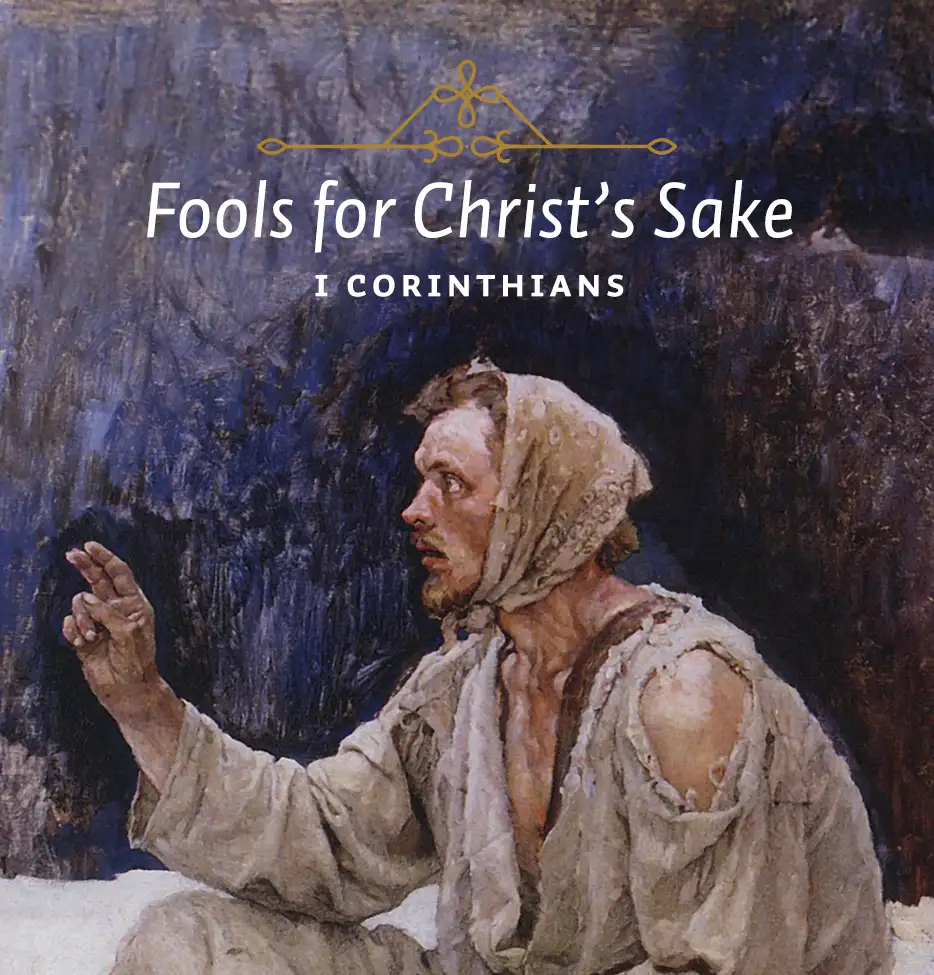
You look at those two groups of people—the Corinthians and the apostles—and the big question you have to ask yourself is this: Who would you rather be? Of course, you know what the answer is supposed to be. But I am not asking you what the answer is supposed to be. I am asking you who would you rather be? Look at your heart and ask, “Would I rather be like Paul? Would I rather be hungry? Would I rather be slandered, abused, persecuted, hated, and hounded from place to place? Or would I rather count myself among these nice people, the ones with all the nice things and the nice clothes, and the nice homes.” Who would you rather be?
I think if we honestly look at our hearts, we would say, “I think I’d rather be with the Corinthians.” And yet, if that is what you really want, you have not understood the tone Paul is using when he refers to the self-sufficiency of the Corinthians. Paul is being sarcastic. Can an apostle be sarcastic? Oh, yes, he can. He is saying, “Already you have what you want. Oh, yes, you do. Already you’ve become rich. Oh, you are rich. You’ve become kings, and you’ve done it all without us. Good for you! I wish that you really had become kings so that we might become kings with you.”
Do you see what Paul is saying? “You think you’re kings, but you’re not reigning. You’re a slave to the values of your world. You look at us, and you say, ‘Look at those poor slaves.’ We’re free because we’re following Christ. It seems to me that God has put us apostles on display at the end of the procession like men condemned to die in the arena. We’re made a spectacle to the whole universe, to angels as well as to men. We are fools for Christ. But you are so wise in Christ. We’re weak, but you are strong. You’re honored; we’re dishonored. To this very hour, we go hungry and thirsty. We’re in rags. We’re brutally treated. We’re homeless.”
I said there are three things Paul uses to describe himself. He regards himself as a spectacle, a fool, and as one who is dishonored or impoverished. But when he says he has become a spectacle, there is more to it than the idea of being paraded before people. Paul knows he has been made a spectacle by God. This is God’s doing because we are His servants. That is what He has chosen to do with us. We are fools, yes, but we are fools for Christ. We are impoverished and dishonored, but it is for the sake of the Gospel, which is a treasure above any earthly wealth.
You must understand that contrast when you ask who you would rather be. Do you want to be like the Corinthians with their wealth that is passing away, and which is going to evaporate when this world is going to be burned up? Or do you want to be like the apostles who have nothing now, and who suffer abuse now, but who hold the treasure of the Gospel and who, through their service to Jesus Christ are laying up an immortal treasure in the world beyond?
This is why as Paul ends the chapter, he tells the Corinthians, “I urge you, then, be imitators of me” (v. 16). Why? Because Paul is imitating Christ. That is what Christ went through. Christ laid aside the glories of heaven, the prerogatives of the Godhead, in order to become like man—and not even a rich man, but a poor man—and to take upon Himself, not just any death, but the death of a cross. That is who Paul follows. Paul was walking close to Jesus Christ, and that is why he tells the Corinthians to imitate him.
Just as God gave the Corinthians in their time people like Paul whom they could imitate because such people were imitating Christ, look for such people today. Do not look to the television for its standards. Do not read the popular magazines for their standards. Do not look to politics for their standards. All those things are passing; they do not mean anything at all. Instead, look for the godly people and follow them, those who know what it means to walk with God and to live for Jesus Christ, in spite of all the hardship and persecution that can come with it.
Finally, by the grace of God try to be a person like that yourself. You may not be like that yet. You may not be able to say, “Imitate me,” because you know in your heart you are not imitating Christ. Try to live that way and become like Christ, so that, as the years go by and as your children come along, they can say, “I want to be like my father because my father follows Jesus.” Or “I want to be like my mother because my mother knows God.” And the people in the church who know you can say, “I want to be like that person because they’re somebody who knows God, and it’s evident in what they do.” And by the grace of God, we will have a generation that follows Jesus. The church will not be divided, and the power of the Gospel will be evident in our world.